Enterprise RAG LLM Architecture, Fine-Tuning & Prompt Engineering: Defending Against Prompt Injection
How to architect production RAG systems, choose between LoRA fine-tuning and vector retrieval, and defend AI agents against prompt injection attacks.
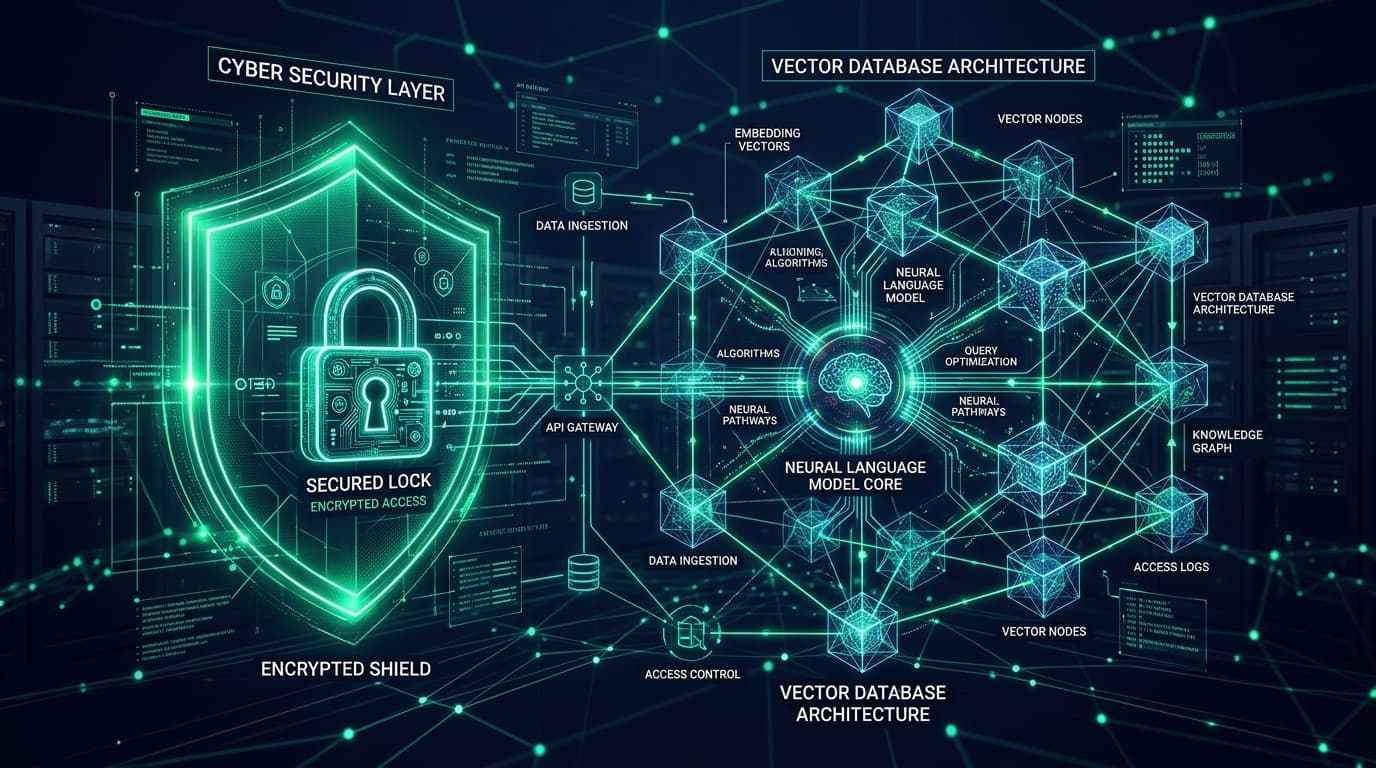
The Anatomy of a Production-Grade RAG Stack
Moving beyond naive prompt wrapping requires an end-to-end Retrieval-Augmented Generation (RAG) architecture. Rather than relying on static model weights that quickly become outdated, RAG decouples knowledge from reasoning. An embedding model converts your company documents, wikis, and databases into high-dimensional vector embeddings stored in a specialized vector database like Qdrant, Pinecone, or pgvector.
Enterprise RAG stacks employ hybrid retrieval (dense vector embeddings + BM25 lexical keyword search) and cross-encoder re-ranking (Cohere Rerank / BGE-Reranker) to pass only the top 3-5 most authoritative chunks into the LLM context window.
When to Fine-Tune vs When to RAG
A foundational decision for engineering teams is choosing between RAG and fine-tuning. RAG is best suited for dynamic, frequently changing knowledge (such as customer documentation, codebases, or financial records) because updating information is as simple as upserting a vector.
Fine-tuning (via Parameter-Efficient Fine-Tuning such as LoRA or QLoRA) is necessary when teaching an LLM specialized domain terminology, deterministic JSON output formatting, or bespoke tone and style. Combining RAG for knowledge retrieval with a fine-tuned small model for task execution yields optimal speed and cost efficiency.

Defending Against Prompt Injection Attacks
As AI agents gain autonomous tool-calling capabilities (interacting with databases, executing terminal commands, and sending emails), security becomes critical. Prompt injection attacks—where malicious user text overrides system instructions—rank as the #1 vulnerability on the OWASP Top 10 for LLMs.
Hardening AI agents requires a multi-layer defense: 1) Strict delimiter isolation using XML tags (<user_input>). 2) Dual-LLM guardrail architectures where a secondary lightweight model audits inputs and tool outputs. 3) Principle of least privilege on tool access tokens.

Frequently Asked Questions
Dense vector similarity captures semantic meaning but frequently misses exact product SKU numbers, error codes, or acronyms. Hybrid search pairs dense embeddings with BM25 lexical keyword matching to guarantee both semantic and exact keyword precision.
Key Architectural Takeaways
- Hybrid search (dense vector embeddings + BM25 keyword matching) and cross-encoder reranking eliminate 90%+ of naive RAG hallucinations.
- Use RAG for dynamic corporate knowledge; use LoRA fine-tuning for structured output formatting and domain tone.
- Prompt injection is the #1 security risk for AI agents; mitigate it with strict XML input boundaries and dual-LLM guardrail filters.
- Implement document-level access control (RBAC) in your vector database to ensure users only retrieve information they are cleared to see.
Need Enterprise RAG or AI Security Hardening?
Our team designs production RAG architectures, integrates vector search, and conducts adversarial red-teaming against prompt injections.